
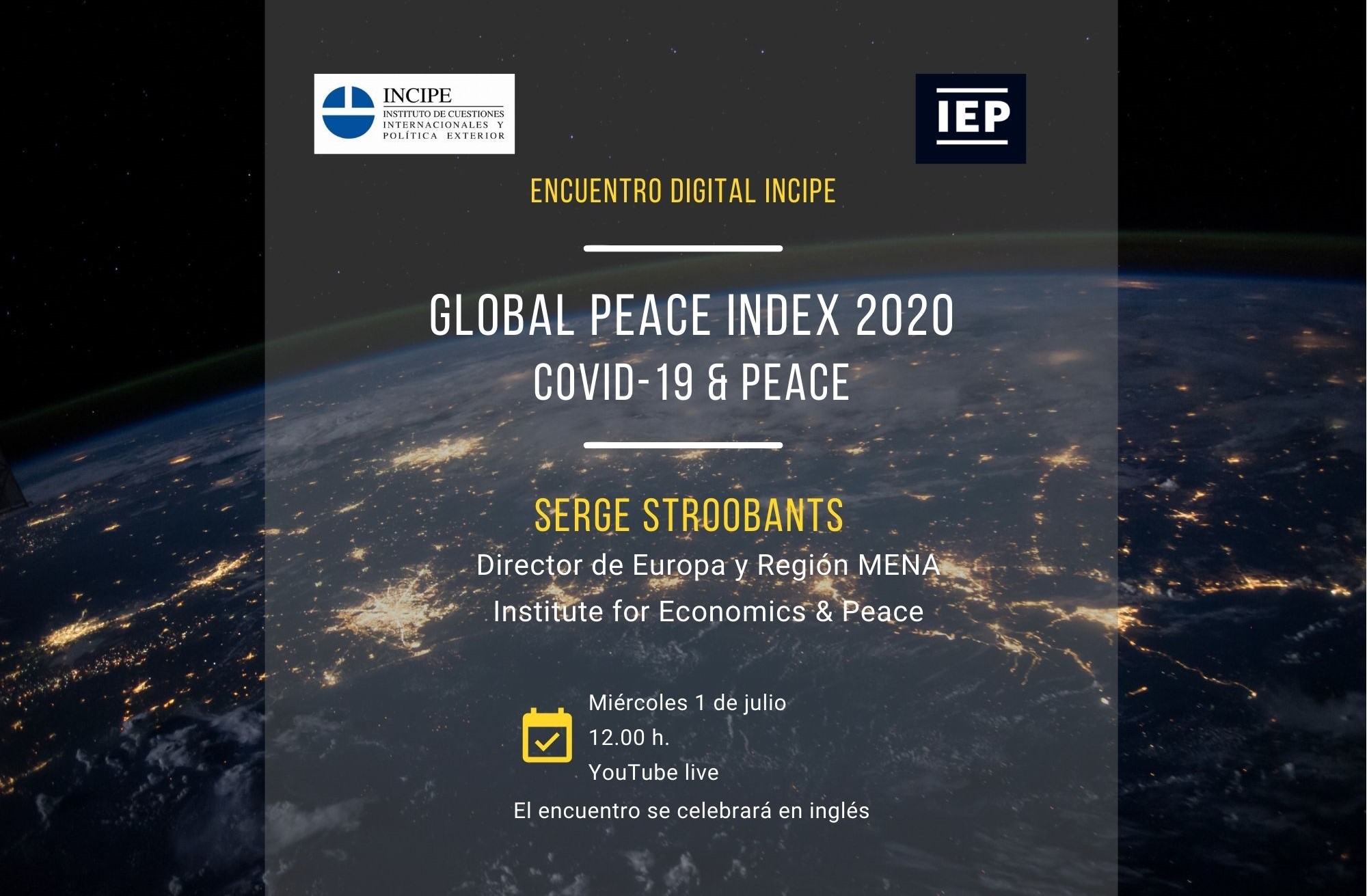
The session was conducted in English and gathered an audience interested in understanding the current state of domestic and international peace indicators. To achieve this, we had the participation of Serge Stroobants, representative of the Australian think tank Institute for Economics and Peace. During the session, Serge Stroobants presented a detailed analysis of the 2020 Global Peace Index report, developed by the Institute for Economics and Peace. This index ranks 163 countries and territories based on their levels of peace through 23 indicators, which can be categorized into three groups: national and international conflict indicators, social security indicators, and militarization indicators.
When analyzing the 2020 results, the speaker pointed out that they revealed a slight global decline in peace of 0.34%, marking the ninth decrease in 12 years. The report also highlights the countries with the greatest improvements, such as Azerbaijan and Armenia, and the main declines, such as Benin and Nicaragua, as well as the persistence of regional patterns: Europe is the most peaceful region, while the Middle East and North Africa remain the least peaceful. Stroobants noted that the data analyzed in the report shows an increasing gap between the most peaceful and least peaceful countries.
The report also emphasizes the economic impact of violence, which in 2020 was estimated at $14.5 trillion, equivalent to 10.6% of global GDP. The speaker also highlighted a special chapter of the report on the effects of COVID-19 on peace, stating that the pandemic has particularly affected countries with the least peace and the fewest economic resources. Moreover, among the countries with high levels of peace, those with weaker economies will face a slower recovery.
Finally, the report explores the relationship between peace and ecological threats, highlighting the growing impact of the climate crisis on global peace levels. As an example, Stroobants pointed out how water scarcity affects regions also marked by high levels of violence.
The session concluded with a debate where participants had the opportunity to ask questions about the topics discussed. This exchange underscored the importance of understanding the analysis of the factors contributing to global peace and stability.
Lucía Rodríguez
Communication Assistant, INCIPE