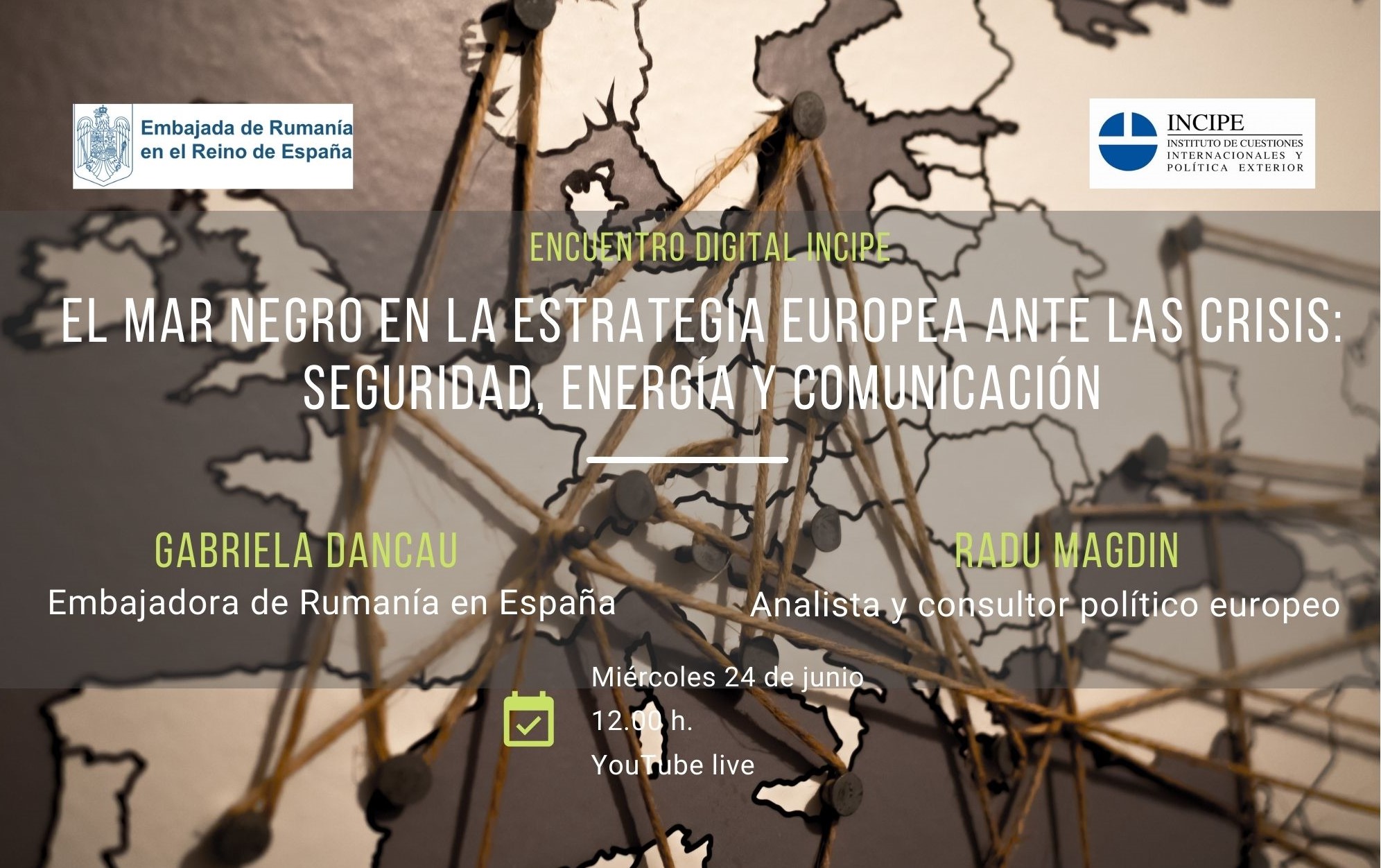
The session was conducted in Spanish and gathered an audience interested in understanding the convergence of national interests of Black Sea countries with other domestic and community interests within the EU, in the context of the pandemic. To this end, we had the participation of Radu Magdin, a political analyst and consultant. During the session, Radu Magdin emphasized the urgency of aligning national interests with community interests to find solutions to the crisis that address the needs of all European states.
The speaker highlighted the importance of efficiency in times of crisis, pointing out a clash between perception, plans, and priorities during emergencies like the COVID-19 crisis. He underscored the disconnect between Brussels and the capitals of member states, fueled by misinformation, which hampers coordinated crisis management. In light of this reality, the speaker proposed integrating regional interests into national agendas, connecting strategic messages with daily needs to ensure that shared priorities are perceived as relevant to both political leaders and citizens.
Regarding the Black Sea, its relevance as a strategic area for the EU was emphasized, with implications for security, energy, and economic opportunities. The speaker proposed continuous dialogue between countries like Spain and Romania to align their national interests with regional and European ones, avoiding internal divisions within the Union. He noted that to build a common agenda, it is crucial to recognize the local interests of various countries as equally important, allowing for a more effective integration of regional priorities into both the national and European contexts.
Finally, the speaker addressed global strategic tensions, such as the competition between the United States and China, which affect dynamics within the EU. Europe is the point of convergence between these powers, so it faces challenges in maintaining a balance in its relations with both and moving toward strategic autonomy. The response to these crises, according to the speaker, requires collective action from all EU countries. The alternative would be the formation of coalitions within the Union, which would end up blocking each other’s particular interests. Additionally, he emphasized the key role of companies and intellectual communities in creating a shared agenda, such as the relationship between Spain and Romania, which could serve as a bridge between the interests of Western Europe and the states near the Black Sea.
The session concluded with a debate where participants were able to ask questions about the topics discussed. This exchange highlighted the importance of understanding the coordination of national and community actions at the European level during times of crisis.
Lucía Rodríguez
Communication Assistant, INCIPE