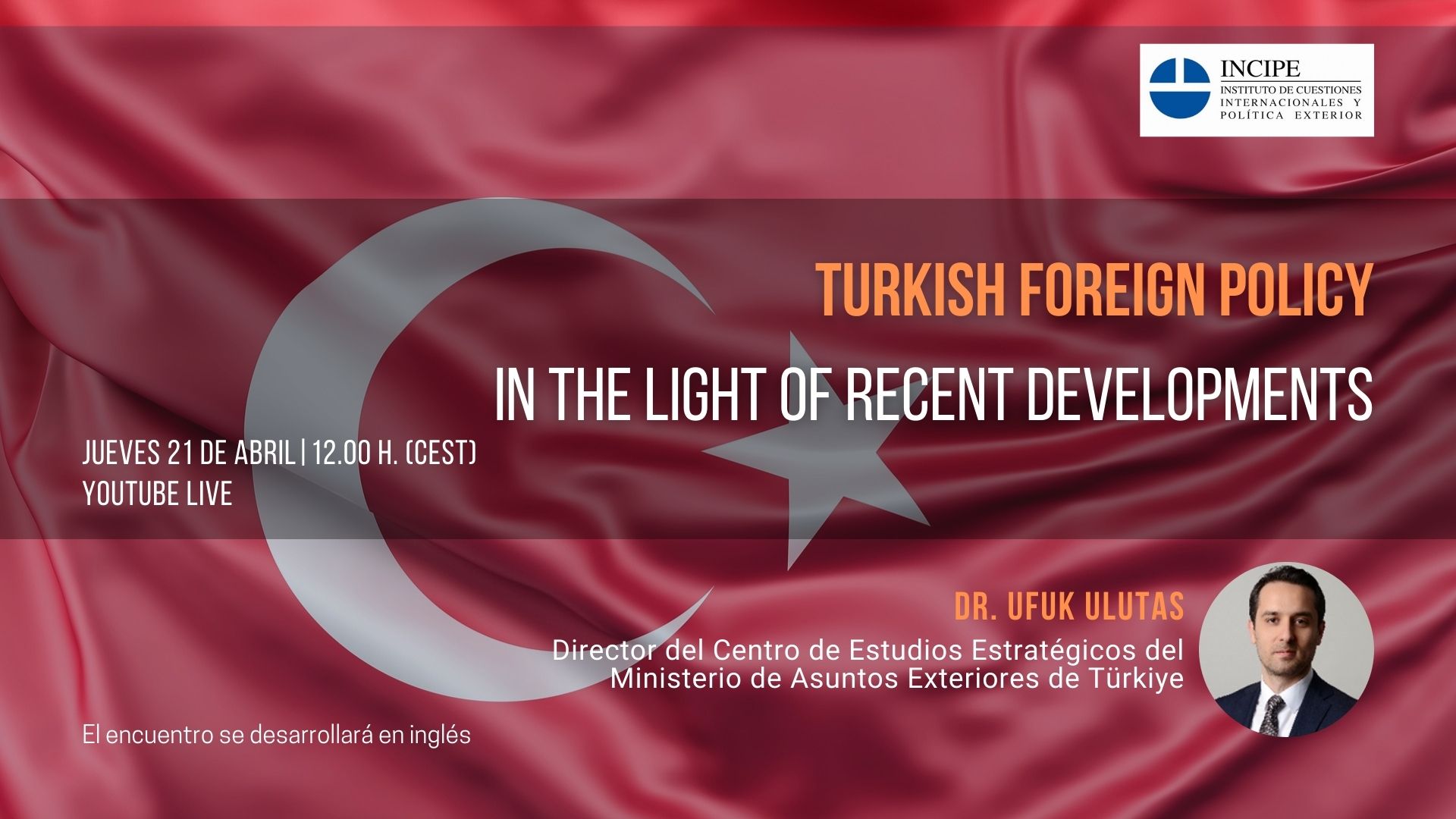
The Ambassador of Turkey to Spain, Burak Akçapar, highlighted at the beginning of the session the importance of the relationship between Spain and Turkey, mainly within a strategic framework due to both countries’ locations at opposite ends of the Mediterranean Sea. This connection has recently been solidified with the signing of a comprehensive partnership during the Spain-Turkey Council last year, taking their relationship to the next level.
Ufuk Ulutaş, Director of the Center for Strategic Studies at the Turkish Ministry of Foreign Affairs, took the floor, emphasizing Turkey’s multidimensional identity, resulting from the many neighboring countries with which it shares borders, as well as the various ethnic groups found within the country and the different international organizations of which it is a part. These factors systematically influence the development of Turkey’s foreign policy.
One of the issues currently shaping Turkish foreign policy is undoubtedly the war in Ukraine. Both Russia and Ukraine have strong ties with Turkey; the relationship with Ukraine is considered multidimensional, while with the Russian Federation, there are areas of both cooperation and competition. Turkey is playing an important role as a mediator, offering channels for dialogue and discussion with the aim of bringing both countries closer to a peace treaty. “If the current war between Russia and Ukraine ever ends, we believe it will be through diplomacy,” said Ufuk Ulutaş.
Another key aspect of Turkish foreign policy is in the Eastern Mediterranean, where Ulutaş mentions the frozen conflict with Cyprus, a clear example of how the Mediterranean can become both an area of cooperation and competition. Finally, Ufuk Ulutaş broadly discussed the situation in the Middle East, a region where countries have different interests, priorities, and perspectives.
To conclude the digital session, a debate was held in which both Ufuk Ulutaş and Mesut Özcan answered questions posed by our participants.
Marta Herranz
Communication Assistant, INCIPE