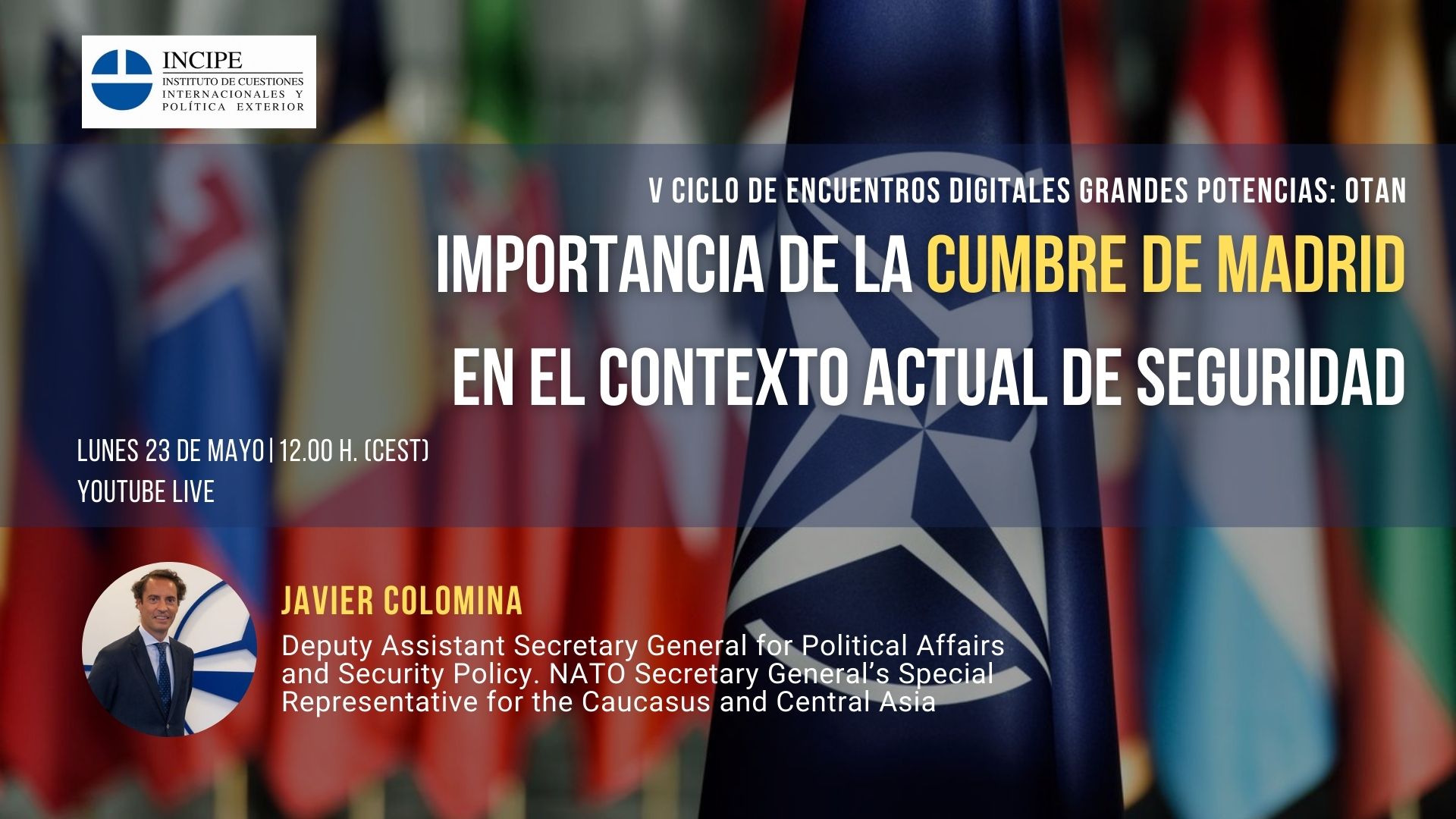
Before addressing the main aspects that demonstrate the importance of the Madrid Summit, Javier Colomina spends a few minutes briefly explaining the role NATO is playing in relation to Russia’s war in Ukraine, in response to the flows of disinformation circulating today. The Atlantic Alliance is fulfilling its most important role since its creation in 1949, which is to prevent a local conflict from escalating into a global one. This is why NATO has increased its deterrence capacity.
The Madrid Summit, which will take place on June 29 and 30, will be a milestone, not only because it will be the first major summit held after the pandemic, but also because the new Strategic Concept will be approved. This adaptation of the strategic concept will be based on the process launched by the alliance called NATO 2030. This project aims to keep the Alliance militarily strong to ensure collective defense. It also seeks to provide the Alliance with a more global character to respond to global threats that put the Euro-Atlantic area at risk. Finally, it assumes that NATO must also take on a more political role, not only involving defense and foreign affairs ministries, but also the presence of other ministerial departments that go beyond security in a broader sense, such as climate change.
Another issue introduced by Colomina is the need to update the strategic concept approved in Lisbon in 2010, given the changes that have occurred in the international order. On the one hand, the Lisbon concept stated that the Euro-Atlantic area was at peace, Russia was considered a partner, and China was not mentioned. Today, this has changed. NATO defined two elements as threats: terrorism and Russia. While terrorism still poses the same level of threat, the relationship with Russia and the balance that existed with the dual track policy—based on deterrence and defense on the one hand, and dialogue on the other—has undergone a major shift, with Russia now being considered not only a threat but also an adversary.
As for China, it will undoubtedly have a fundamental presence at the Madrid Summit, given the current security challenges posed by the country. Therefore, a redefinition of the relationship is expected, with an effort to maintain a balance in the security challenges it poses, increase the Alliance’s resilience, and find areas of shared interest with China.
Ultimately, the spotlight of the Madrid Summit will be on the approval of the new Strategic Concept, as it has been impacted by the conflict in Ukraine. NATO will set the work guidelines for the coming years, based on the three essential tasks previously outlined: collective defense, cooperative security, and crisis management. Now more than ever, Article 5 is of utmost importance, as is cooperative security. The evolution of crisis management will also be necessary, with more surgical and specific operations. For all these reasons, the Madrid Summit is of vital importance in the current security context we find ourselves in.
Judit Anidjar
Communication Assistant, INCIPE