
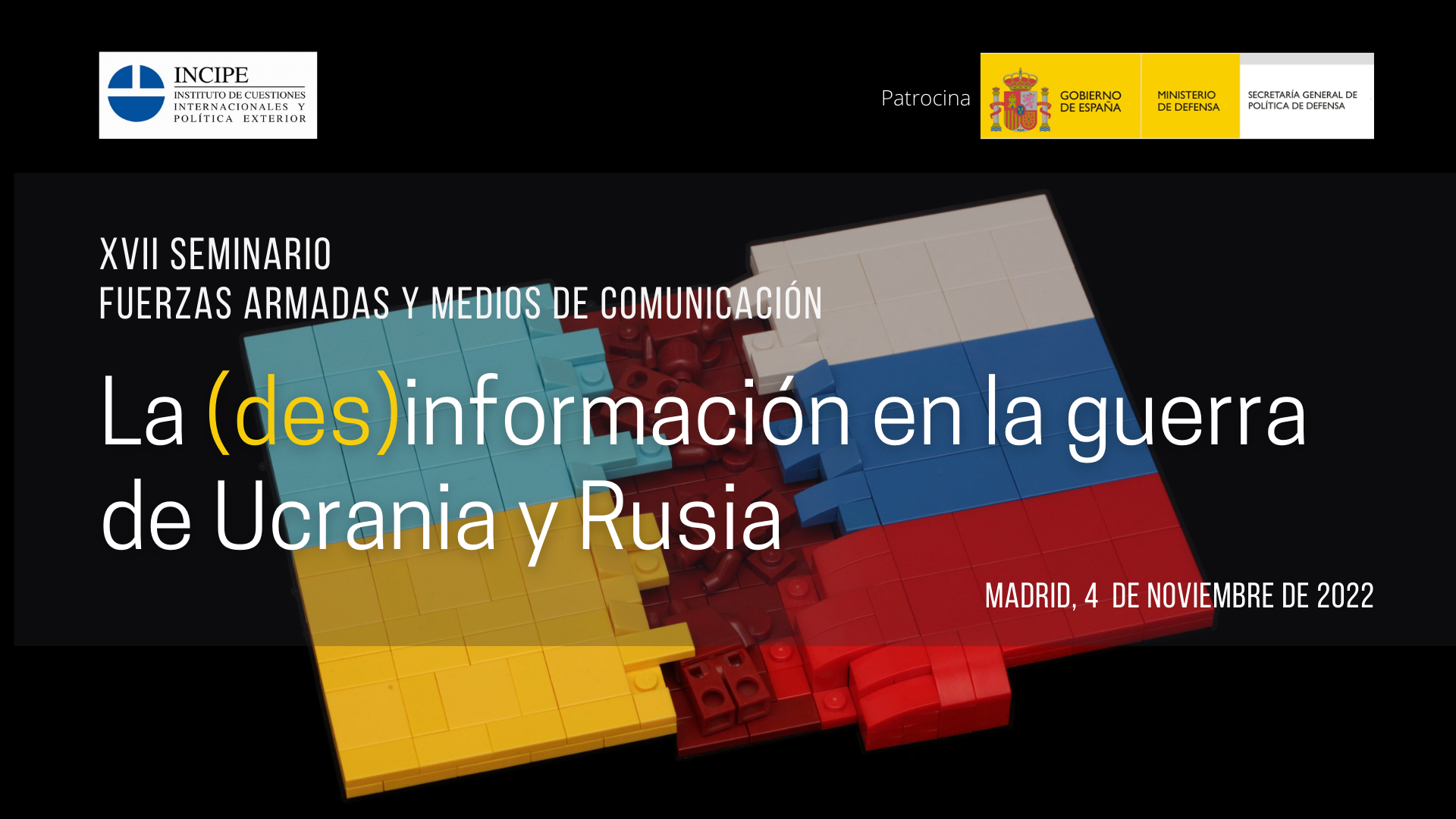
In this session, we had the opportunity to organize two roundtables. The first, titled The Ukraine-Russia Conflict: The First Great Total Hybrid War? was moderated by Vicente Garrido, General Director of INCIPE, and featured Colonel Luis Alberto Hernández, Head of the Analysis and Foresight Section (SEAYP), Joint Chiefs of Staff; Ruth Ferrero, Professor of Political Science and European Studies at UCM; and Guillem Colom, Professor of Political Science at Pablo de Olavide University and Co-Director of THIBER. The second roundtable, The Informational Treatment of the War in Ukraine, was moderated by Colonel Domingo Jarillo, Head of the Communication Office of the EMAD, Ministry of Defense. It included Pilar Requena, International and Investigative Reporter and Director of Documentos TV, RTVE; María Sahuquillo, Journalist and Head of the Brussels Delegation (formerly in Moscow) for El País; and María Senovilla, Independent Journalist and Photographer currently covering the war in Ukraine.
DIGENPOL, TG Fernando López del Pozo, began his speech by emphasizing the historical importance of the relationship between the military (especially in campaign) and the media. From Napoleon’s disastrous campaign in Egypt to the CNN effect during the Gulf War, there has always been a need for the military to impose its narrative over that of the other side. Now, this is compounded by the effect of new technologies, which lead to “information overload” and exposure to disinformation, key issues for security and defense. Systematized in military doctrines, the Army now speaks of the cognitive domain and the domain of information as a cross-cutting matter. DIGENPOL states that the traditional information closure of the Armed Forces has evolved into a communicative openness in service to society. In this relationship, “giving” and “confirming” are key to producing truthful, thorough, and timely information.
It is necessary to clearly separate behaviors and sensations in peace and war regarding communication. In peacetime, journalism is essential for democracy, contrasting the information provided by public authorities. During a conflict, the situation is less clear, as journalists, whether they wish to or not, cannot be neutral and must take sides. Specifically, in the case that concerns us now, DIGENPOL summarizes Ukrainian communication policy as open, centralized from the top, and with a highly image-focused network vision. Meanwhile, the Kremlin has adopted a policy of self-legitimization and demonization of the other side. The so-called grey zone, where informational campaigns proliferate aimed at division and disinformation, requires continuous work to ensure security and defense. We must know in order to stay alert and unmask those pieces of information designed to distort reality.
The Ukraine-Russia Conflict: The First Great Total Hybrid War?
During the first roundtable, The Ukraine-Russia Conflict: The First Great Total Hybrid War?, Col. Luis Alberto Hernández began his intervention with a conceptual review of hybridity and the grey zone. The term hybrid is not necessarily new, as it draws inspiration from recent conflicts in Chechnya, Lebanon, or Afghanistan, as well as from earlier ones like the American and Spanish independence wars. The colonel provides a series of definitions that combine elements of special/irregular operations and conventional combat: the so-called “composite wars” of Thomas M. Huber, which were replaced in 2007 by Frank Hoffman’s concept of “hybrid warfare”; with the addition of terrorism and organized crime to the two previous elements.
Particularly notable is the view of Russian General Valeri Guerásimov (2013), who explains the importance of certain non-military factors as elements to achieve strategic and political goals against sophisticated adversaries. He focuses on the comprehensive approach to addressing operations and conflicts, with what he terms “hybrid warfare” being comparable to the Western concept (first used by NATO in 2011 and then by the EU in 2014) of a “comprehensive approach.” From there, the evolution of the concept is attributed to the global economic interconnection and the exponential growth of technology, facilitating the entry of economic, energy, cyberspace, and cognitive information domains alongside conventional tools. Social networks and the individual in the form of the smartphone or smart phone have become central.
Regarding the concept of the grey zone, which originated in 2015, Col. Luis Alberto Hernández notes that it refers to a spectrum where conflict has expanded to periods of peace and post-conflict. It is characterized by actions outside the bona fide interaction between states, which, although they disrupt peace, do not cross the threshold to be considered war proper. On the other hand, hybrid strategy is defined as communication to articulate the instruments of state power in a multidimensional and integrated way, in order to directly or indirectly attack an international competitor. In other words, it consists of targeting their systemic weaknesses for coercive purposes. The role of the Armed Forces shifts to deterrence and escalation control (which consists of the phases of configuration, interference, and destabilization).
In her intervention, Ruth Ferrero frames the current situation within the theoretical framework of Clausewitz. The selective leakage of information to the public and the use of a hybrid strategy is occurring on both sides, including the Western bloc. Ruth Ferrero emphasizes the importance of listening to our systemic rivals (Guerásimov and Chinese military doctrine) regarding the hybrid conflict, as well as contrasting the Russian and Western narratives. Regarding the Kremlin, Ruth Ferrero describes its adaptation to an unexpected Ukrainian strategy, reinforcing the narrative of NATO threat and anti-American imperialism, and transforming offensive warfare into defensive. It thus seeks to exploit the underlying discourses in the public opinion of its potential allies in the global South. The role of the Orthodox Church is now much more present and explicit than at the start of the aggression, through the concepts of “de-satanization” and “de-nazification,” which the EU must counteract through active use of its information.
As the third participant in this thematic block, Guillem Colom informs us that the post-Cold War world, exemplified in Francis Fukuyama’s The End of History, is coming to an end as the American military supremacy that once supported the liberal order is fading. Revisionist powers eager to change the international status quo are consolidating, and the logic of the so-called strategic competition between powers is emerging, as seen in the 2017 and especially the 2018 U.S. National Security Strategy. In a zero-sum system, where systems compete with one another without leading to armed conflict, the grey zone proliferates, with hybrid threats such as disinformation, cyberattacks, and economic and political warfare, among others. This framework complicates public attribution and identification, facilitates the plausible denial of responsibility, and hinders the capacity for response.
Colom emphasizes the need to revisit the debates on so-called new generation wars during the 1990s, with Russia and China highlighting the importance of information in a broad sense (for targeting, command and control, intelligence, etc.). The so-called “sixth and new generation wars” emerge, where the informational component is combined with “wars without contact,” involving limited long-range artillery exchanges to maintain a logic of deterrence. In contrast to the U.S. multidomain doctrine, where the informational aspect is fundamental, Russia is still struggling to coordinate kinetic fire with cyber fire.
The Informational Treatment of the War in Ukraine
In the second roundtable, Colonel Domingo Jarillo reminds us that we are witnessing what may well be one of the most media-intensive wars in history, one whose full extent and consequences we will only be able to grasp once it has concluded. The informational treatment of this conflict is significantly complicated by the oscillation between opacity and an excess of data, which makes the task of presenting an accurate narrative all the more challenging.
Pilar Requena, the first journalist to address this theme, points out that truth is often the first casualty of war. While she concurs with Colonel Jarillo that this may be the war with the highest number of journalists on the ground, she also highlights the homogeneous coverage provided by Western media. She warns against the censorship of Russian propaganda outlets, arguing that this deprives experts of the opportunity to analyze developments from the other side. Regarding Zelensky, she observes the existence of an underlying, carefully constructed narrative of which we have little knowledge, as well as the tacit acceptance of the lack of press conferences from the president, his ministers, and military leaders. In contrast, the Russian regime relies heavily on censorship and harassment of the press, a strategy that has contributed to complete opacity.
Requena emphasizes the double standards in the treatment of refugee flows, pointing out a dimension that undermines the credibility of the European Union as a defender of human rights and freedom. She insists that the media has overly focused on the destruction, suffering, and victims of the conflict, often idealizing Ukraine as a perfectly democratic and transparent country. Citizens have been denied insight into the terrain, sources of propaganda, and disinformation, as well as the context of the country since the Euromaidan. Instead, a singular, rigid narrative is being promoted, leaving little room for alternative opinions. This will likely require deconstruction once the old realities reemerge at the end of the conflict.
María Sahuquillo begins her intervention with a personal analysis of media coverage in Moscow and Donbas. Like Pilar Requena, she stresses the importance of historical, geostrategic, and analytical knowledge to combat disinformation, extending beyond the more immediate concerns. She emphasizes the importance of “scratching beneath the surface” and understanding the language used in the coverage. Drawing from her experience as a correspondent, she discusses how the Kremlin has systematically dismantled civil society to prevent the formation of dissenting groups and the use of bellicose rhetoric to deny Ukraine’s sovereignty within the power circles.
Through her “sandwich theory,” Sahuquillo explains the significance of not relying on sources that have repeatedly demonstrated systematic falsehoods. She rejects the idea of presenting as headlines information from Russia that cannot be substantiated and is suspected to be false. Using the metaphor of a drop of poison in a glass of water, she illustrates the contaminating impact that disinformation has on the public, eroding trust in the media and undermining the faith that democratic societies place in freedom of expression and information. Russia’s role in this disinformation campaign is particularly striking as it operates without fear of self-contradiction.
Finally, María Senovilla, participating remotely from Ukraine, explains how information control and the management of disinformation on social media have become additional tools of warfare. She describes the strategies of both actors, noting Ukraine’s tight control over journalists and Russia’s dissemination of fake news and classic 20th-century propaganda. Focusing on the Kremlin, she highlights that, beyond state control over media, pro-Russian influencers have taken over the networks with significant reach. This phenomenon is not limited to Russia, Belarus, or former Soviet territories but extends to Spanish-speaking countries like Venezuela, Argentina, and even Spain. This suggests that Russia has been cultivating these networks for years, turning these regions into both commercial and ideological allies. It prevents us from concluding that the Kremlin has lost the war for public opinion—this is only true for the segment of society, which is neither the majority nor the totality, that had the tools to discern factual news from fake news and had an interest in the country’s developments before the conflict erupted. In the less informed or specialized part of the population, doubt has been successfully sown.
On the ground, while part of Russian propaganda has relied on classic tools of 20th-century warfare, such as radio and television, another part has focused on terror. The credibility that radio holds in many households in occupied regions, as well as the repetition of the message, has allowed disinformation to permeate easily. The press was distributed alongside the scarce humanitarian aid reaching occupied zones, while torture chambers served as a warning to the Ukrainian population. In the Ukrainian territories, while the “war of numbers” (casualties, arsenal, strategy, etc.) is key and forces a certain opacity, the deprivation of information—evident as the conflict progressed—has caused discomfort among the press and hampered their ability to report properly.
Closing Remarks
Brigadier General Francisco Dacoba was the one who closed the Seminar, reminding everyone that disinformation campaigns have a long history predating the conflict discussed here. The use of force has never excluded at least the attempt of disinformation, deception, persuasion, or demoralization, though it has gained new prominence with new technologies. In Spain, the National Security Strategy, in effect since December 2021, already included them as risks and threats, on par with traditional conflict. He states that far from merely changing its nature, the armed conflict has also become more complicated, combining the realities of the 19th, 20th, and 21st centuries simultaneously. The conflict is played out in societies—not just foreign ones, but also domestic ones—seeking to delegitimize democratic institutions, causing immeasurable harm. The center of gravity in the gray zone is the citizens, whose perceptions are at stake. In addition to the traditional dimensions of land, sea, and air, the second half of the 20th century added outer space and cyberspace, where disinformation campaigns find fertile ground in the near-impunity of diffuse legality. As a result, the sixth domain, the cognitive one, must be protected at the highest level against any violation, as part of a basic exercise in human rights.
Sofía Provencio
Communication Assistant, INCIPE