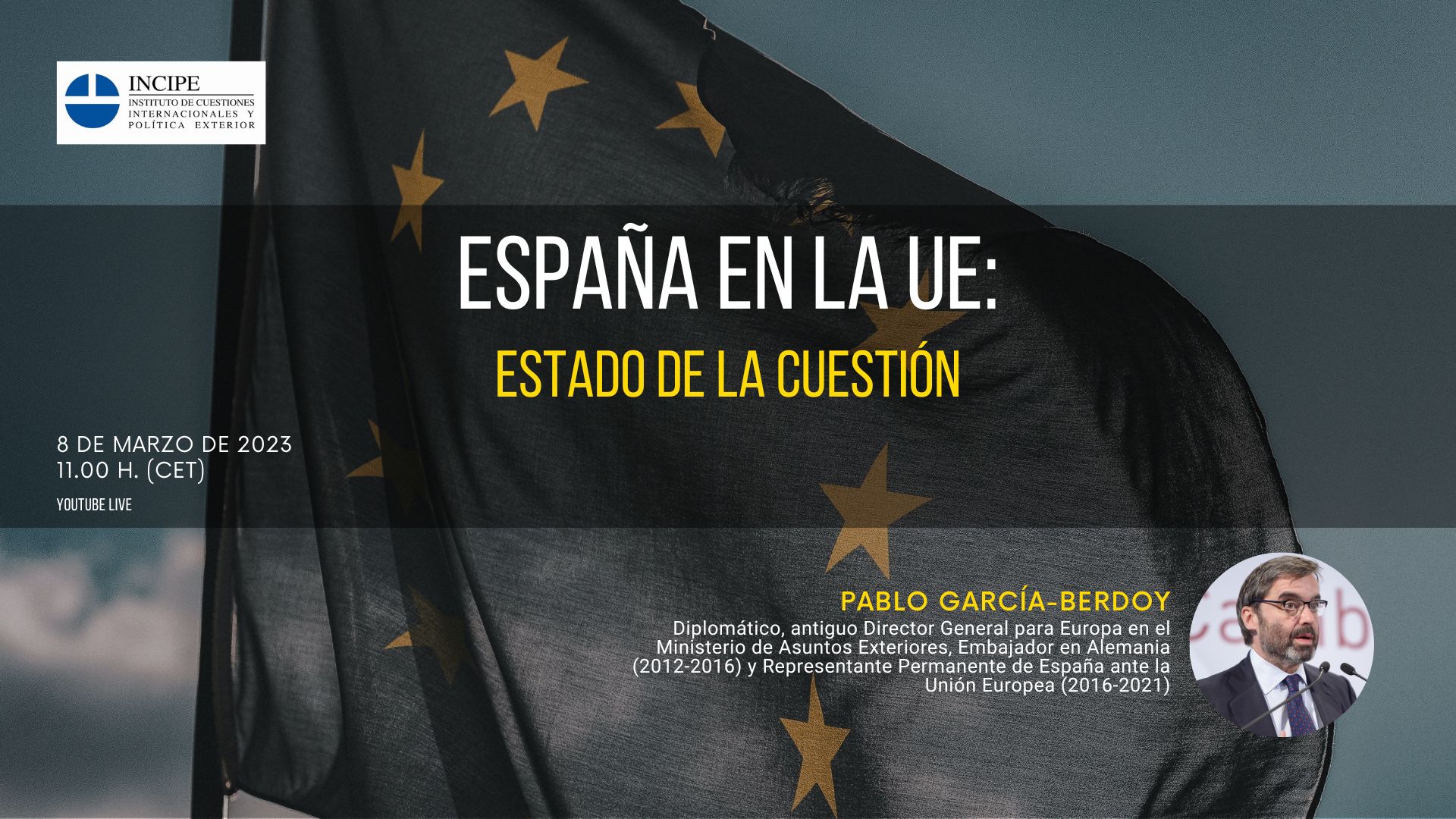
García-Berdoy begins his participation by stating that there is a misunderstanding about the origin and nature of European integration, which contributes to diluting the importance of this basic competence of the modern European state. The states, as the owners of the Treaties, understand that the EU is the necessary framework for making effective the policies they once decided separately and now jointly in a shared institutional framework of which they are the holders. The European process, therefore, is a fundamental part of the government’s responsibility, a priority projection of national sovereignty and the political mandate that the executive has received from its citizens. This view of the state as a co-owner of the process as a whole is the correct one.
While warning that the Union must adapt to the new times, García-Berdoy divides Spain’s membership in the EU into four periods. The first begins with Spain’s accession to the European Communities and ends in 1999 with the confirmation of Spain’s membership in the eurozone since its inception. During that time, Spain experienced the highest growth rate in the OECD, but there were large imbalances in the Spanish economy, which led to four devaluations of the peseta and a very strict budget adjustment starting in 1996 to meet the Maastricht Treaty criteria. In parallel, the most important historical event after the signing of the Treaty of Rome occurred: the fall of the Berlin Wall.
In the second stage, the beginning of the 21st century in the EU is marked by the preparation for the great enlargement, and in Spain, by a change in preferred alliances. Apart from Iraq, Spain had found many points of agreement with the United Kingdom, especially concerning the development of the internal market. The enlargement required a refoundation that had already started in Maastricht, and these were years of relentless intergovernmental negotiation following Amsterdam, Nice, the failed constitutional treaty, and Lisbon. Spain, the small among the big, initially succeeded in securing its weight in the Council, but the Lisbon Treaty reduced it with its double majority system in a council with 25 and later 28 member states. This second part concludes with the euro crisis from 2008, where the new government sought to return to Spain’s traditional European policy, fostering a friendlier relationship with the Commission and the Franco-German axis, a supposed European orthodoxy.
From 2008 to 2014, the European Union lived through its worst period; the management of survival (the third stage for Spain). For García-Berdoy, Spain has still not recovered from the 2008 crisis, and our position in Europe and the world is weaker than before that crisis. Regarding the fourth stage, it began in 2015 with the onset of the migration crisis that summer, awakening Germany from its uncomfortable role as hegemon. The mass arrival of migrants, mostly from Syria, sparked a wave of populism in many European countries and an east-west confrontation over the different views on European migration policy. In this fourth period, Brexit took place, a negotiation well-handled by the European Commission that dismantled the British myth of regained sovereignty, a somewhat delicate situation due to the negative news of the British exit.
Continuing with this last stage, Pablo García-Berdoy establishes that the COVID crisis and the extraordinary European response with the approval in December 2020 of the Next Generation EU recovery fund could have brilliantly closed this period if it hadn’t been for the Russian invasion of Ukraine. When the time comes for Spain to preside over the Council of the Union, it must open the debate on the insufficiency of funds for North Africa, as the stability of its surroundings and its relevance in the EU are at stake. In addition to the pandemic and the Ukraine crisis, globalization, the China-US competition, the digital revolution, the crisis of multilateralism, and the environmental challenge, among others, point to a gradual delegation of sovereign powers to the Union. But this delegation must respond to Spanish interests. In sum, after these years of integration turmoil, with huge activity from the institutions, the outlook is uncertain for Spain as a Member State. García-Berdoy believes that no one is more to blame for this than the Spaniards themselves.
In response to the questions raised during the debate, Ambassador García-Berdoy states that discussions should open towards a neighborhood policy, as Ukraine or Moldova today cannot enter a rapid negotiation process for their accession. Furthermore, the Brussels-UK agreement on Northern Ireland is beneficial, and the future Gibraltar-EU relationship is extremely important. On his part, INCIPE’s Secretary General, Manuel Alabart, concludes by emphasizing the opportunity for Spain to address the relationship with Gibraltar and neighborhood policies.
Jaime Osorio
Asistente de comunicación, INCIPE