
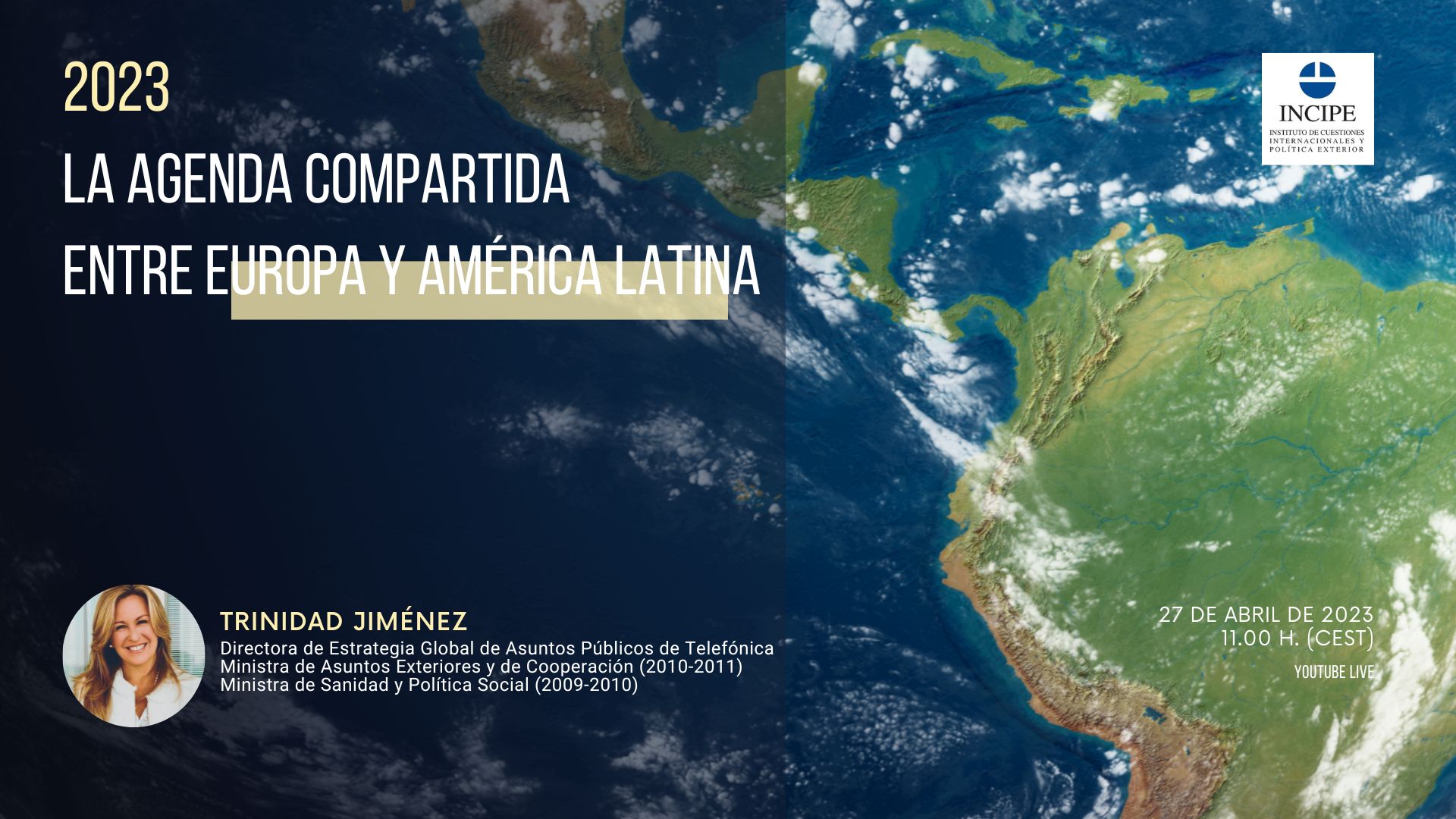
During the conference, the current state of relations between the European Union and Latin America was discussed, highlighting the favorable opportunity that 2023 presents to reactivate, promote, and strengthen these ties. If there are regions in the world that can reinforce their bonds, they are Latin America and the EU. According to Jiménez, Latin America is a true giant, endowed with great biodiversity and a much larger young population than that of the EU—characteristics that should be highly attractive to the EU.
Undoubtedly, Latin America still faces numerous challenges, including high inflation rates—a problem affecting many other countries worldwide—poverty, inequality, significant social fragmentation, and a high level of informal labor. One of the key aspects highlighted by Trinidad Jiménez is the region’s vulnerability to climate change.
Given this context, it is worth considering whether a reinforced cooperation is appropriate at this time, as suggested by Trinidad Jiménez. It is noteworthy that Latin America consists of 33 countries, 27 of which have signed trade or political association agreements with the EU, while Mexico and Brazil hold strategic partnership status. Additionally, three of these countries—Brazil, Argentina, and Mexico—are G20 members, while four—Costa Rica, Chile, Mexico, and Colombia—are members of the OECD. These figures demonstrate the strong pre-existing relationship between the EU and Latin America.
Latin America is positioned as a key trade partner, and despite China’s investments in the region, the EU remains the primary direct investor. Although the EU has had to focus its efforts on addressing urgent issues in its immediate neighborhood, this does not mean it lacks a genuine interest in Latin America.
The year 2023 presents an opportunity to reinvigorate bi-regional cooperation, with several positive developments in this regard. These include the recent Ibero-American Summit held in the Dominican Republic in March, the visit of Commissioner Vestager to Colombia to improve digital infrastructure, and, thirdly, the CELAC-EU Heads of State Summit—a significant milestone, considering it had not been held since 2015.
Trinidad Jiménez recalled the words of European Commission President Ursula von der Leyen in her 2022 State of the Union address, where she underscored the strategic importance of Latin America for the EU. Jiménez also emphasized that with Spain holding the Presidency of the EU Council, the Latin America agenda is naturally being resumed. She referenced the trade agreements currently under negotiation between both regions, particularly highlighting the challenge of finalizing the EU-Mercosur agreement this year. This agreement is highly significant for both regions, as Mercosur represents approximately 260 million consumers and constitutes the fifth-largest economy outside the EU. However, strong political will from both sides is essential to finalize these agreements.
It is crucial to stimulate the interest of EU member states in Latin America. Spain, in particular, has maintained a consistent interest in the region and is the EU’s leading investor in Latin America. If the goal is to build a multipolar world, the EU must consider Latin America as a partner with whom to strengthen mutually beneficial ties. Jiménez stressed that this is the ideal year to do so.
In her conclusions, Jiménez highlighted the importance of the strategic EU-LATAM-U.S. triangle as a means to strengthen relations and achieve a position of power on the global stage. She also emphasized the need for continuous political dialogue between the blocs and for supporting Latin America in its triple transition: social, economic, and digital-energy. Additionally, Jiménez argued that there is no competition between relations with Africa and those with Latin America, as there is sufficient room to maintain relationships with both.
Regarding legal security in Latin America, Trinidad Jiménez noted that changes in legal frameworks are a constant not only in the region but also in many other countries worldwide. These changes, she pointed out, can occur for various reasons—ranging from fiscal crises to pandemics—and are not necessarily tied to the political ideologies of governments.
Danela Bordones
Asistente de comunicación, INCIPE