
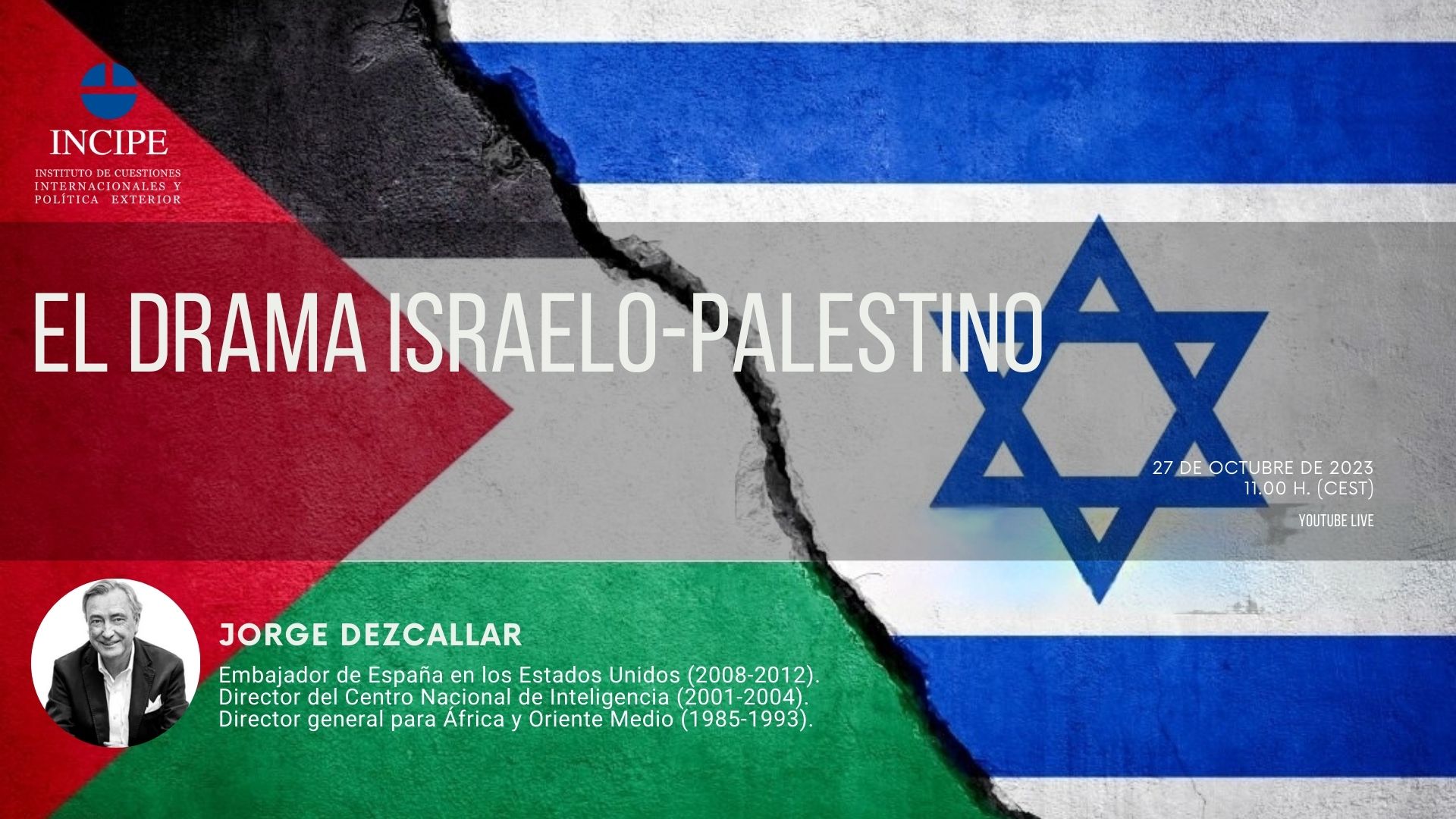
Jorge Dezcallar began his intervention by analyzing the context of the attack carried out by Hamas on October 7 and attempting to determine what went wrong in Israel’s defense. He states that there were several serious intelligence failures and that it is almost impossible that the extensive preparation Hamas undertook for the attack went unnoticed by Israeli intelligence services. He asserts that an investigation will be conducted, and responsibility must be taken for these failures, particularly for the overconfidence shown by the intelligence services.
He highlights that Israeli society is polarized, with a prime minister accused of corruption and an army more focused on defending settlers in the West Bank than on paying attention to the danger coming from Gaza. Regarding the origin of the problem, Dezcallar notes that the unconditional support from the United States, which Israel has always relied on, has allowed it to ignore United Nations resolutions. He also attributes the outbreak of violence to Palestinians feeling their cause was being forgotten. Therefore, he lists four objectives that Hamas may have had in carrying out its attack: attempting to ensure the world does not forget the Palestinian issue, assuming Palestinian leadership, preventing rapprochement between Israel and Saudi Arabia, and securing the release of prisoners from Israeli jails in exchange for hostages.
Israel’s response has been to unite and declare war to defeat Hamas and regain the population’s trust. Dezcallar is clear that Israel will win this war due to the vast differences in strength, but it will result in a humanitarian disaster. Regarding the international reaction, he highlights that for Russia, this situation demonstrates the failure of American policy in the Middle East, while China believes Israel’s response exceeds self-defense and constitutes an unacceptable form of collective punishment. For the global South, this highlights the hypocrisy of the West, which condemns the Russian invasion of Ukraine but overlooks the years of Israeli occupation in Palestine.
Dezcallar points out four short-term dangers arising from this situation: confusing Palestinians with Hamas, the risk of terrorism potentially reaching Europe, the humanitarian disaster this will cause, and the potential extension of the conflict. At the same time, he identifies four situations this conflict will likely trigger: Hamas will no longer govern Gaza, Netanyahu will struggle to survive politically, the situation will harm Ukraine, and finally, Israel’s reaction will favor Hamas, gaining them more support from the Palestinian population.
Lastly, Dezcallar lists three major future problems, at short, medium, and long-term stages. First, he emphasizes that humanitarian pauses are imperative, and the issue of hostages must be addressed. Second, he underscores that this military operation will be very difficult, and Israel will have to carry it out while avoiding a humanitarian disaster that could harm its international reputation, with the potential for global attention and conflict extension. Finally, in the long term, Dezcallar reminds that Israel will face the enormous problem of what to do with Gaza, where two million inhabitants have nowhere to go.
In the final segment of the session, a debate took place, where participants asked questions about issues such as the two-state solution and its geographical obstacle, as well as the possibility of a confederation. The Israeli strategy and the possible reaction of Iran were also discussed. Additionally, the validity of international humanitarian law and the double standards that may be applied by the West were debated. Finally, the impact this situation will have on the development of the war in Ukraine was discussed, along with different options for international mediation to end the conflict between Israel and Hamas.
Aranzazu Álvarez