
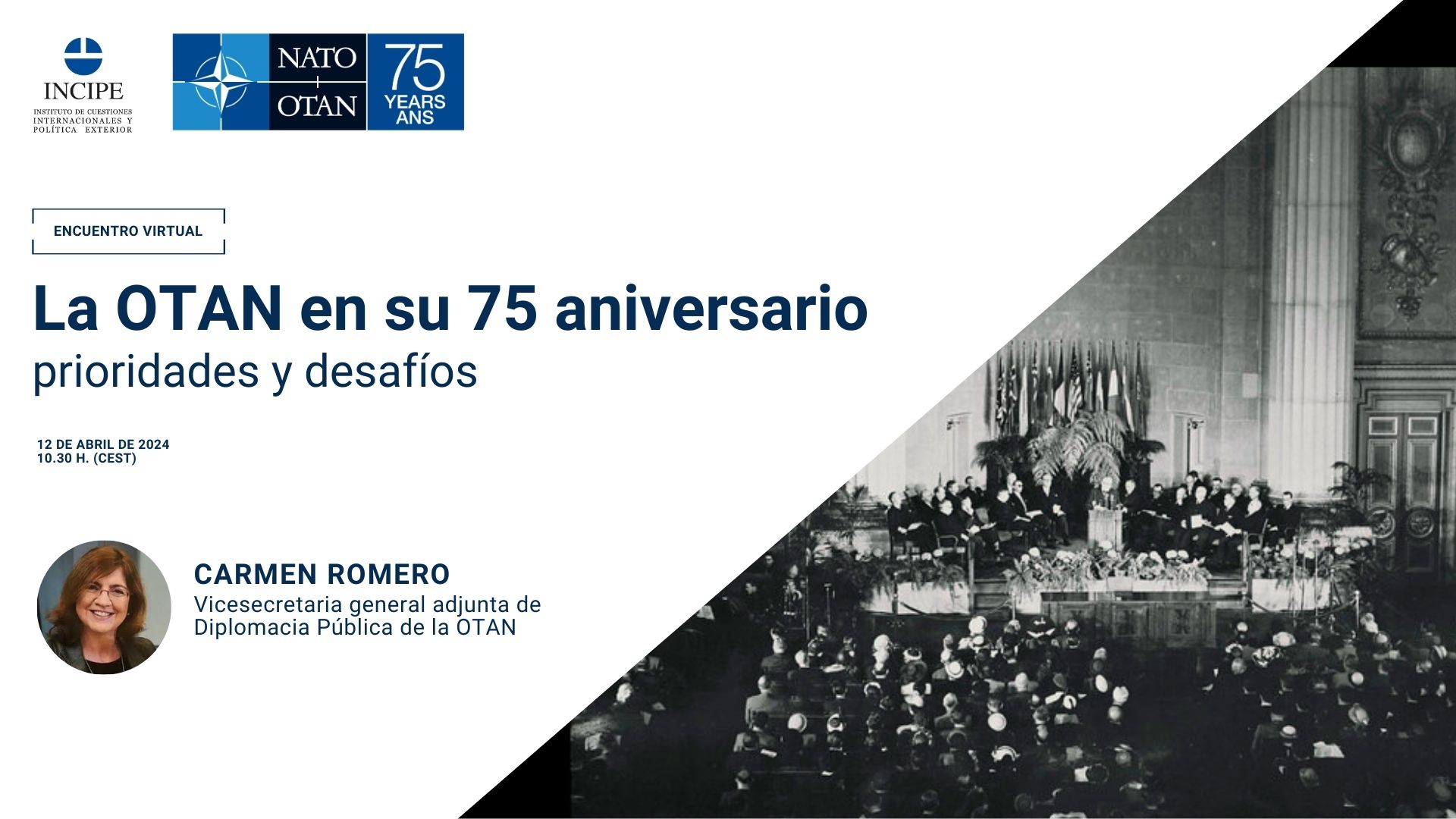
Carmen Romero began her speech by highlighting NATO’s crucial role throughout its 75-year history. She pointed out that one of the key moments of the anniversary celebrations will take place in July, when Heads of State and Government gather in Washington. This milestone offers an opportunity to recognize the Alliance’s role, especially in today’s highly complex security landscape. We are facing threats that endanger not only our security but also our way of life, including a war on European soil. Additionally, we are dealing with increasing global strategic competition and ongoing challenges such as hybrid and cyber threats, terrorism, and the security implications of climate change.
“NATO is needed now more than ever,” stated NATO Secretary General Jens Stoltenberg. Along the same lines, Romero emphasized that “the good news is that we have a strong NATO.” The Alliance now has more members than ever before, growing from its original twelve founding members to thirty-two countries, with the recent additions of Finland and Sweden. It also boasts highly prepared military forces, increased defense investments, and the largest global network of partners in its history.
NATO is primarily a political-military organization that protects over one billion people across the Euro-Atlantic area. Carmen Romero pointed out that 90% of the European Union’s citizens live in a NATO member country. The Alliance relies on both political and military tools to ensure security. She highlighted that NATO is the only forum where North American and European countries meet daily to discuss critical security issues. All decisions are made by consensus, prioritizing collective security over individual national interests. The military component helps implement political decisions through deterrence and defense, aiming to prevent conflicts rather than provoke them. NATO is a defensive, not offensive, organization—ready to defend itself if necessary, but always seeking to prevent escalation and operating within the principles of the United Nations Charter.
Carmen Romero posed a key question: Why is NATO still relevant 75 years after its creation? The answer, she said, lies in its ability to adapt. The Alliance was originally founded to deter the Soviet Union, playing a crucial role for 40 years in ending the Cold War and protecting citizens and territories. After that long period, NATO expanded its focus beyond collective security, engaging in operations beyond its borders and contributing to conflict resolution in the Western Balkans. Following the 2001 terrorist attacks, NATO assumed a leading role in counterterrorism, a mission it continues today.
After the Cold War, Russia shifted from an adversary to a partner, and practical cooperation was established within the broader security architecture. However, Russia’s annexation of Crimea in 2014 and its occupation of territories in Donbas fundamentally altered NATO’s security outlook. After 30 years of stability and prosperity, NATO reactivated its collective defense strategy in ways not seen since the end of the Cold War. Additionally, the terrorist threat escalated with the emergence of groups like ISIS in the Middle East.
In response to Russia’s aggression against Ukraine, NATO has demonstrated unwavering unity. Its response is built on three pillars: supporting Ukraine’s right to self-defense, reinforcing deterrence and defense to prevent the conflict from spreading to NATO member states, and working with Alliance partners as part of an international coalition to uphold international law.
Following Carmen Romero’s speech, a discussion took place where participants raised questions on NATO’s enlargement process, NATO-EU relations, and member states’ commitments to defense spending, among other topics.
Aranzazu Álvarez