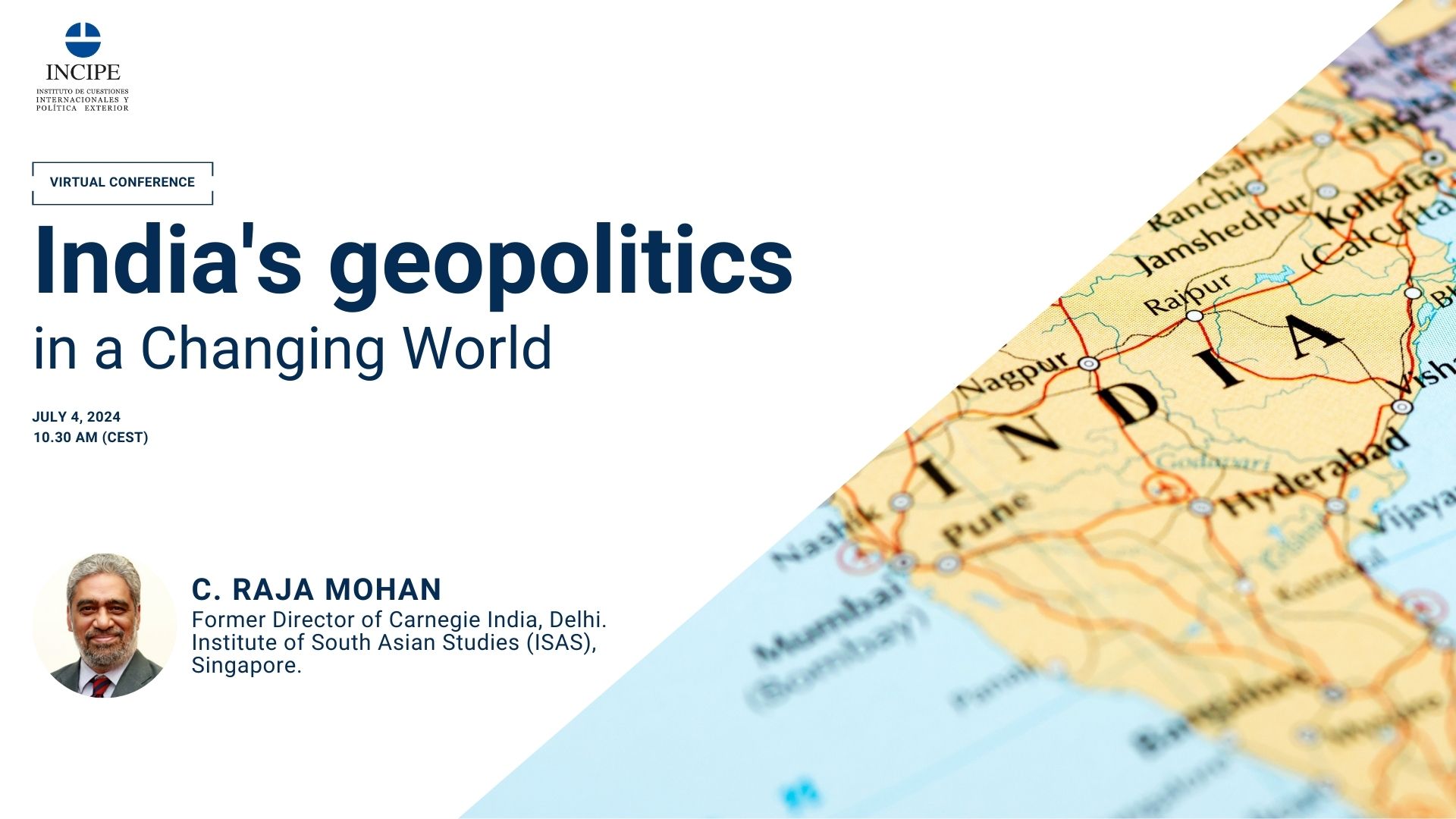
The session took place in English and gathered an audience interested in understanding India’s emerging role in an increasingly complex and dynamic global context. The speaker, Raja Mohan, currently a researcher at the Asia Society Policy Institute in Delhi and with extensive experience in key institutions such as the Institute of South Asian Studies and Carnegie India, provided a detailed analysis of India’s growing geopolitical influence, particularly focusing on its role in the Indo-Pacific region. It was emphasized that India is emerging as a key actor in the region, strengthening its bilateral and multilateral relations, and actively participating in shaping international norms, such as space and cyberspace governance.
Raja Mohan began his intervention by referring to the current context, which he described as one of the most turbulent moments in global politics since the end of the Cold War, driven by the return of war to Europe and the resurgence of great power rivalry. Tensions between the United States and China have grown in Asia, and their consequences could be even more significant than what we are witnessing as a result of the war in Ukraine.
Mohan pointed out that, after nearly 30 years of relative peace in the international system, the current great power rivalry promises to disrupt the world in the coming years. This is compounded by the assumption made in the early 21st century that the world could unite into a single market, where capital and labor could easily flow across borders, leading to the construction of a postnational world through WTO structures and deeper global economic integration. The idea of a globalist economy has crumbled in recent years, due to the pandemic and the deterioration of U.S.-China relations. We are now witnessing the return of geo-economics, so to speak, instead of geopolitics.
Artificial intelligence (AI) has emerged as a transformative global force, with a profound impact on sectors such as biotechnology, the economy, and politics. This technological advance promises to disrupt not only global economies but also the military balance and the political structure of democracies. In this context, India positions itself as a rising economy, projected to become the third-largest economy in the world in terms of nominal GDP. However, it faces significant challenges due to its low per capita GDP and the need to manage its international relations in an environment of great power rivalry, limiting its ability to play a broader role on the global stage.
Economically, under Narendra Modi’s leadership, India has implemented proactive policies to promote sustained and inclusive economic growth. The country has embarked on initiatives such as Make in India to foster domestic manufacturing, encourage investment, and improve its global competitiveness. According to International Monetary Fund (IMF) projections, India’s economy is expected to continue rising in global rankings, reaching third place in terms of nominal GDP by 2030.
India’s economic development plan seeks not only to expand its industrial and technological base but also to address internal challenges such as poverty, uneven development, and environmental sustainability. According to World Bank reports, India has managed to reduce extreme poverty by 10% since 2019, but it remains a crucial challenge for its internal stability. In this regard, President Modi has set the goal of transforming India into a high-middle-income economy by 2031 and a developed country by 2047, celebrating the centenary of its independence with a significant milestone in national development.
In the context of the Indo-Pacific, India has adopted a more proactive stance, promoting maritime security and economic cooperation. These initiatives not only strengthen trade and strategic ties with regional powers but also position India as a key counterbalance to China’s growing influence in the region.
Additionally, Professor Mohan pointed out how the strategic rivalry with China has shaped India’s foreign policies, seeking to expand its military and diplomatic presence and strengthening alliances with the United States, Japan, and Australia through the Quad mechanism. This trilateral and quadrilateral collaboration seeks to counter China’s expansionist ambitions and maintain regional stability.
India has the third-largest military and the third-highest military spending. The major challenge for India has been how it uses its size and influence in the international system and how it leverages this influence to accelerate its internal development, bring greater prosperity, and ensure greater peace and stability in the world around it. These are India’s real objectives as we look to the future, stated Raja Mohan.
The session concluded with a debate where participants were able to ask questions on the topics covered. This exchange underscored the relevance of better understanding India’s emerging role in global geopolitics and its implications for global stability.
Aranzazu Álvarez